
Let me be honest with you—keeping up with crypto markets is exhausting. Prices move 24/7, opportunities flash by in seconds, and trying to make manual trades? Forget about it. That's where AI-powered trading bots come in.
If you've been sitting on the sidelines watching others profit from DeFi while you sleep, this is your wake-up call. In 2026, AI trading bots aren't just a luxury—they're becoming essential for anyone serious about maximizing their crypto portfolio.
But here's the real question: Are they actually worth it? Can they really deliver on the hype? Let's dig in.
Why AI Trading Bots Are Actually Game-Changing Right Now
Look, I get it. The phrase "AI trading bot" sounds like something out of a sci-fi movie. But the reality is way simpler and honestly, way more exciting.
These bots do one thing incredibly well: they execute trading strategies faster and more consistently than humans ever could. No emotions. No FOMO. No panic selling at 3 AM when the market dips.
Here's what's changed in 2026:
The technology has matured significantly. Early DeFi bots were clunky, unpredictable, and honestly, kind of terrifying. Today? They're sophisticated, transparent, and integrated seamlessly with major protocols like Aave, Uniswap, and Curve.
The biggest shift is that AI models can now analyze market sentiment across social media, on-chain data, and technical indicators simultaneously. They're processing information that would take a human hours to digest—in milliseconds.
How These Bots Actually Work (Spoiler: It's Not Magic)
Let me break down the mechanics without getting too technical.
Step 1: Strategy Definition
You tell the bot what you want it to do. For example: "If Bitcoin drops below 60K,buy500 worth. If it hits $65K, sell and lock in profits."
Step 2: Market Monitoring
The bot constantly watches the markets, analyzing price action, volume, and other indicators you've specified.
Step 3: Automated Execution
When conditions are met, the bot executes the trade instantly—no delays, no second-guessing.
Step 4: Portfolio Rebalancing
Many advanced bots automatically rebalance your portfolio to match your target allocation. If tech tokens pump and suddenly represent 50% of your portfolio instead of 30%, the bot automatically sells some tech and buys other assets.
The beauty? It happens while you're at work, at the gym, or actually living your life.
The Types of Strategies These Bots Use
Different bots specialize in different approaches. Here are the ones actually working in 2026:
Grid Trading
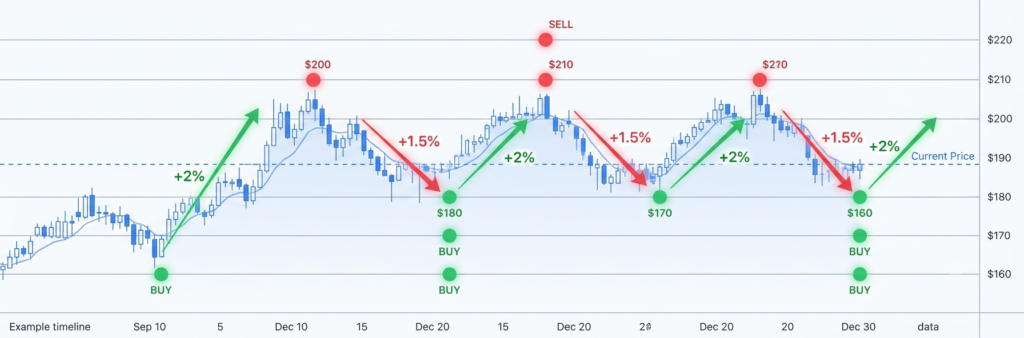
This one's perfect for volatile markets. The bot places buy orders below the current price and sell orders above it—creating a "grid" of trades. Every time the price bounces between those levels, the bot captures small profits. It's boring. It's consistent. It works.
Arbitrage Bots
These hunt for price differences across exchanges. If Bitcoin trades at $63K on Coinbase but $63,050 on Kraken, the bot buys on Coinbase and sells on Kraken, pocketing the difference. The profits are small per trade, but volume is king here.
DeFi Yield Farming Optimization
These bots move your liquidity to the highest-yielding pools automatically. Yearn Finance pioneered this, and now dozens of platforms do it. The bot continuously searches for the best yields, moves your funds, and handles gas fees efficiently.
Trend Following
When momentum builds, these bots ride the wave. They're programmed with technical indicators that identify trends and enter positions early, then exit before the inevitable reversal.
Mean Reversion Strategies
This assumes that prices that deviate too far from their average will eventually return. The bot buys when an asset is down significantly, betting it'll bounce back. Works great during consolidation phases. Terrifying during true crashes.
Okay, But What Are the Actual Returns?
Here's where I need to be real with you.
Honest returns from trading bots typically range from 15-40% annually for conservative strategies, with aggressive approaches potentially hitting 50-100%+ during bull markets. But—and this is important—there's no guarantee.
A bot running a grid strategy might generate consistent 2-3% monthly returns. A yield farming bot might target 15-25% APY. An arbitrage bot might hit 40-80% annually if it's efficient with gas fees.
But remember: past performance ≠ future results. Market conditions change. Strategies that crushed it in 2025 might flop in 2026.
The edge of using AI bots isn't necessarily massive returns—it's consistent, emotional-free execution of a proven strategy. That's worth something serious.
The Real Risks You Need to Know About
No discussion about crypto bots is complete without talking about what could go wrong.
Smart Contract Risks
Even the best-audited contracts can have vulnerabilities. There's always a non-zero chance of exploit or loss of funds.
Market Conditions Change
A strategy that works perfectly in a bull market might drain your portfolio during a bear market. You need to monitor and adjust.
Impermanent Loss (for Liquidity Providing Bots)
If you're providing liquidity, you need to understand impermanent loss. When price movement is extreme, you might end up worse off than just holding.
Exchange or Platform Risk
If the exchange goes down or the platform gets hacked, your funds could be at risk. Always use reputable, audited platforms.
Over-Leverage
Some bots can use leverage to amplify returns. But they can also amplify losses. Tread carefully here.
The Best Platforms to Get Started (2026 Edition)
1. Yearn Finance
Best for: Passive yield farming
Why it rocks: Industry-leading strategies, audited, user-friendly. You deposit, it optimizes automatically.
2. dYdX
Best for: Advanced traders
Why it rocks: Sophisticated trading tools, low fees, excellent for shorting positions.
3. Uniswap Bot Integrations
Best for: Liquidity provision
Why it rocks: Direct integration with Uniswap V4, automated fee tier management.
4. 3Commas
Best for: Custom trading strategies
Why it rocks: Highly customizable, connects to multiple exchanges, great charting tools.
5. Shrimpy
Best for: Portfolio rebalancing
Why it rocks: Automatic rebalancing, tax loss harvesting, super intuitive interface.
How to Actually Get Started (Practical Steps)
Step 1: Start Small
Never deploy your entire portfolio into a bot you've never tested. Start with 500−1000 max.
Step 2: Choose Your Strategy
What's your goal? Consistent income? Capital growth? Risk tolerance? Match this to the right bot strategy.
Step 3: Backtest Everything
Most good platforms let you simulate the strategy against historical data. Do this before deploying real money.
Step 4: Monitor the First Month
Watch daily. Understand what's happening. You need to know if the bot is working as expected.
Step 5: Scale Slowly
If things are working after a month, increase your capital. But do it gradually—never throw all your eggs in one bot.
Step 6: Keep Learning
Markets evolve. Strategies need adjustment. Stay curious and keep tweaking.
Common Mistakes People Make
Setting It and Forgetting It
The biggest mistake. Market conditions change. Strategies that worked last month might not work this month. Check in weekly at minimum.
Over-Complicating Strategies
Simpler usually beats complex. A bot running grid trading with five parameters beats a bot running 47 different indicators.
Ignoring Gas Fees
In bull markets, high gas fees eat into returns. Make sure your strategy accounts for this.
Not Diversifying Strategies
Don't put all your capital into one bot or strategy. Use multiple approaches across different bots.
Trusting Unaudited Code
Always check if the smart contracts have been audited. Unaudited code is unaudited risk.

The Future of AI Trading Bots in DeFi
We're just scratching the surface. Here's what's coming:
- More Sophisticated ML Models: Bots that actually learn and adapt from market conditions in real-time
- Cross-Chain Arbitrage: As interoperability improves, bots will arbitrage across different blockchains seamlessly
- Regulatory Integration: Better tax reporting built into bots automatically
- Community-Driven Strategies: Decentralized networks where traders share and vote on strategies
- Quantum-Ready Algorithms: Preparing for the cryptographic shifts coming with quantum computing
Final Thoughts
AI trading bots aren't a magic money machine. But they're also not snake oil.
If you're disciplined, understand the risks, start small, and monitor your positions, they can genuinely improve your crypto returns. More importantly, they buy you back time to focus on things that actually matter.
The best time to start was last year. The second-best time is today.
Start small. Test thoroughly. Scale slowly. And for God's sake, don't bet the farm on any single bot or strategy.
Your future self will thank you.



Leave a Reply