The Conversation That Happens Every Day In Indian Homes
Your friend says: "Bro, I made ₹2 lakh on Bitcoin last month."
You think: "That's cool, but isn't crypto a scam? Isn't it for rich people? How do I even buy it?"
Your mom says: "People lose everything on crypto. I read it in WhatsApp."
Meanwhile, 50 million Indians have already figured this out. They're not getting rich overnight. They're not losing everything either. They're treating crypto like what it actually is: a new asset class, similar to stocks or real estate, but digital.
Here's the problem: Crypto content in India is either:
- Too technical: "Blockchain uses SHA-256 cryptography and distributed ledger technology..." (Your eyes glaze over)
- Too hype: "Bitcoin will make you a millionaire!" (Your spidey-sense tingles)
- Too scary: "Crypto is a Ponzi scheme!" (Your mom shares this)
None of this helps you actually understand what's happening.
So let me be clear about what this post is: A practical guide for an Indian who has ₹100 to spare and wants to understand crypto without the BS.
Not financial advice. Not hype. Not fear-mongering.
Just the truth.
Part 1: What Is Crypto, Actually? (Without the Jargon)
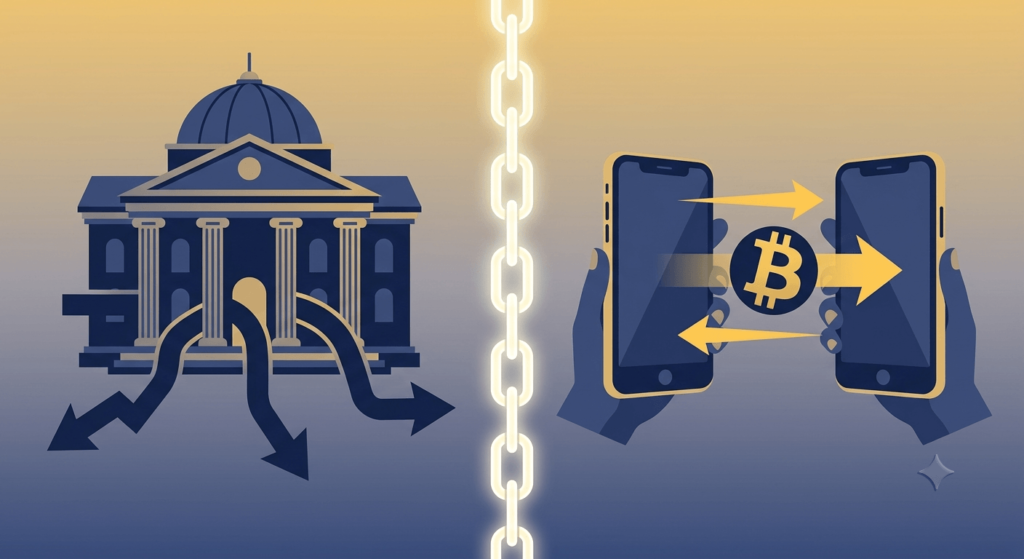
Bitcoin isn't magic. It's not some scam. It's a digital currency that works without a bank in the middle.
Think of it like this:
Normal payment: You send money to a friend via bank → Bank takes a fee → Bank checks if you have money → Bank transfers it → Takes 2-3 hours.
Bitcoin payment: You send Bitcoin to a friend directly → No bank involved → Takes 10 minutes → No middleman fee (or very small).
That's the core idea.
Bitcoin is a ledger. A record book. But instead of being stored in a bank's office, it's stored on thousands of computers around the world, all updating simultaneously. This is called a "blockchain."
Here's why that matters:
No single person or government controls Bitcoin. It can't be censored. It can't be shut down by a bank. It can't be frozen (unless the person holding it allows it).
For Indians, this is actually huge. In 2021-2023, the Indian government restricted crypto trading several times. But Bitcoin kept running. You couldn't be stopped from using it.
But here's the catch: Bitcoin is slow and expensive for everyday payments. It costs ₹500-1,000 in fees to send ₹10,000. So most people don't use it for payments. They use it as an investment — like gold. You buy it, hold it, sell it later.
Part 2: The Four Types of Crypto (And Why You Only Need to Care About Two)
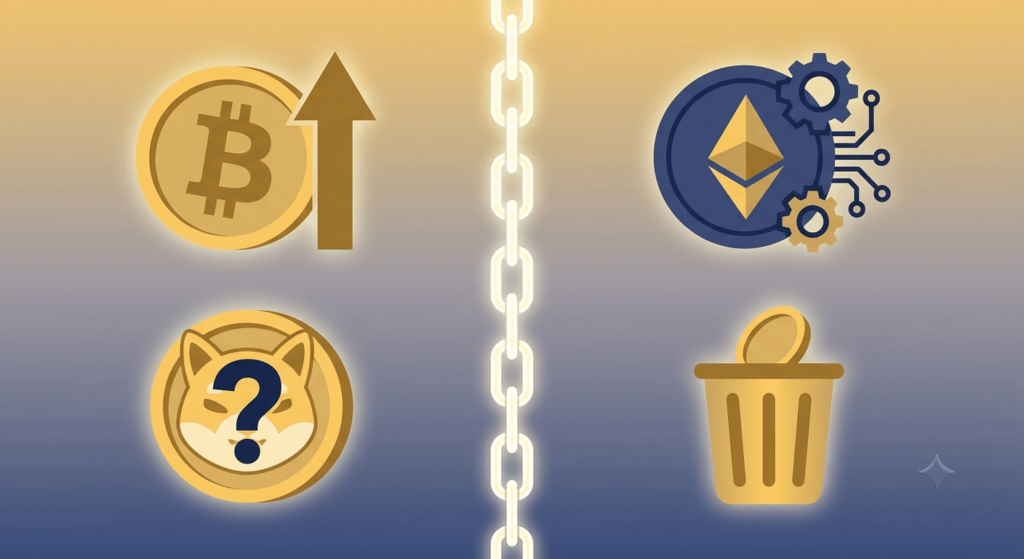
1. Cryptocurrency (Bitcoin, Ethereum)
These are digital money. Bitcoin is like "digital gold." Ethereum is like "digital oil that powers a computer network."
Both are used as:
- Investments (you buy and hold hoping the price goes up)
- Payments (you can send them directly to someone)
- Collateral (you can borrow against them)
Should a beginner care? Yes. These two represent 70% of the entire crypto market. If you buy one, buy these.
2. DeFi Tokens (Uniswap, Aave, Curve)
These are tokens that represent ownership in financial services that run on the blockchain.
Example: Uniswap is a place where people trade cryptocurrencies directly with each other — no exchange, no central company. If you own a Uniswap token, you own a piece of the fees generated when people trade there.
Should a beginner care? Not immediately. Come back to this after 6 months of understanding Bitcoin and Ethereum.
3. Meme Coins (Dogecoin, Shiba Inu)
These started as jokes. Dogecoin literally has a dog as its logo. But people bought them, the price went up, and suddenly they're worth billions.
Here's the truth: These are pure speculation. You're betting that someone else will pay more for them tomorrow. There's no real use case. Sometimes people get rich. More often, they lose money.
Should a beginner care? No. Seriously, skip this entirely until you understand the first two categories.
4. Shit Coins (literally hundreds of thousands of them)
These are new cryptocurrencies launched every day with no real purpose. 99% of them are either scams or collapse to zero.
Should a beginner care? Absolutely not. Avoid these like you'd avoid a "guaranteed 50% return" investment from your cousin.
Part 3: Here's What Makes Crypto Different (And Why People Get Excited)
The Stock Market Closes at 3:30 PM
You can't sell your stocks after hours. You can't trade at 2 AM.
Bitcoin never closes. You can buy or sell at any time — 2 AM, midnight, Sunday, Diwali. The market never stops.
This is useful if you're traveling, or if news breaks at odd hours and you want to react immediately.
There's No "Growth Season"
Stock prices often move together — when the market is up, all stocks go up. When it's down, all go down.
Bitcoin moves independently. When global stock markets crashed in 2020, Bitcoin went up 300%. When stock markets recovered, Bitcoin went up another 500%. It doesn't follow the same patterns.
This means a portfolio with stocks AND Bitcoin has less volatility. You're less likely to lose everything if one market crashes.
(This is why seasoned investors allocate 5-10% of their portfolio to crypto. Not to get rich. To diversify.)
Speed and Cost of Transfers
Sending ₹5 lakh to someone in the US via bank:
- Cost: ₹2,000-5,000 in fees
- Time: 3-5 business days
- Process: Fill forms, wait
Sending ₹5 lakh in stablecoins (crypto tied to the US dollar) to someone in the US:
- Cost: ₹10-50
- Time: 10 minutes
- Process: Copy their address, send
For Indians sending money abroad — especially freelancers, NRIs, or people doing cross-border business — this is a game-changer.
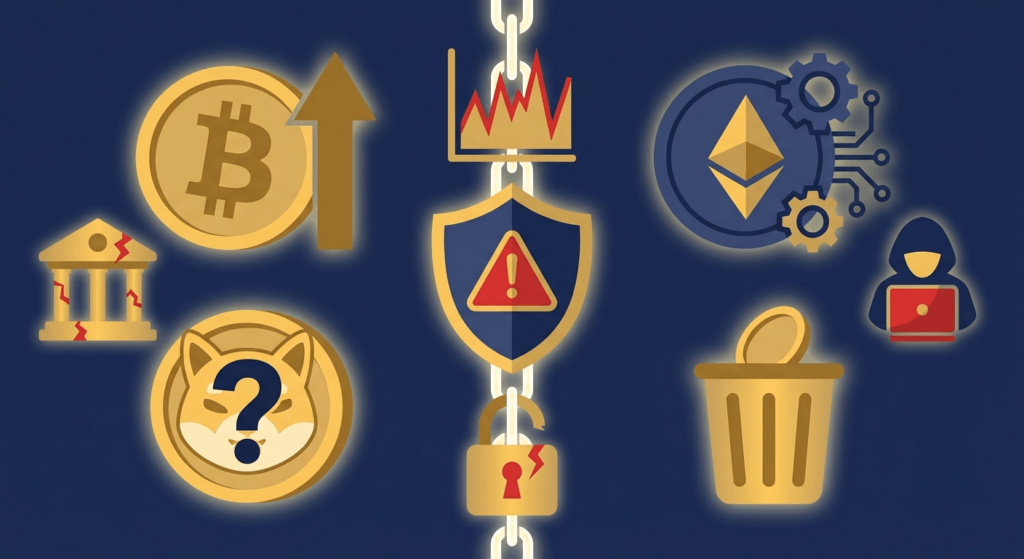
Part 4: The Real Risks (Not the Scary Stories)
Risk 1: Price Volatility (You Lose Money in the Short Term)
Bitcoin's price swings wildly. One day it's ₹27,00,000. The next week it's ₹22,00,000. If you panic-sold, you locked in the loss.
How to manage it: Only invest money you can afford to lose. If ₹1 lakh makes you lose sleep when it drops to ₹80,000, invest ₹10,000 instead. Or use dollar-cost averaging (buy ₹500 every month instead of ₹1 lakh once).
Risk 2: Scams (Fake Coins, Fake Exchanges, Fake WhatsApp Groups)
Someone in a WhatsApp group says: "Join our new crypto coin. It's going to be the next Bitcoin. Buy now, guaranteed returns."
You buy it. The creators dump their coins. The price collapses to zero. Your money is gone.
This happens weekly in India. Here's how to avoid it: Only buy Bitcoin and Ethereum. Never buy any new coin someone is promoting. If someone is promoting it, it's already a red flag.
Risk 3: You Lose Your Password (Your Money Disappears Forever)
This is the scariest one and it's completely real.
You buy ₹1 lakh of Bitcoin. You write the password somewhere. You lose the paper. Years later, you can't access it. That ₹1 lakh is locked away forever. You can see it on the blockchain. You can't access it.
This happens more often than you think. Billions of Bitcoin are lost this way.
How to manage it: Use a proper crypto wallet (we'll cover this below) and keep your passwords in multiple places — a locked drawer, a safe deposit box, your email drafts folder.
Risk 4: Exchanges Getting Hacked or Shutting Down
You keep your crypto on an exchange (like CoinDCX or WazirX). The exchange gets hacked. Your crypto disappears.
This is rare (major exchanges have insurance), but it happens.
How to manage it: Keep most of your crypto in a "cold wallet" (a separate device, like a hardware wallet) that's not connected to the internet. Only keep what you're actively trading on an exchange.
Risk 5: Government Ban
India restricted crypto trading multiple times. What if it bans it entirely?
Here's the truth: The Indian government is moving toward regulation, not a ban. There's a difference. Regulation means you can own crypto, but need to pay taxes. A ban means you can't.
Right now (2026), it looks like regulation is happening. Which is actually good — it means the government is taking it seriously instead of ignoring it.
But yes, this is a real risk. If India bans crypto tomorrow, its value might crash. This is why you only invest what you can afford to lose.
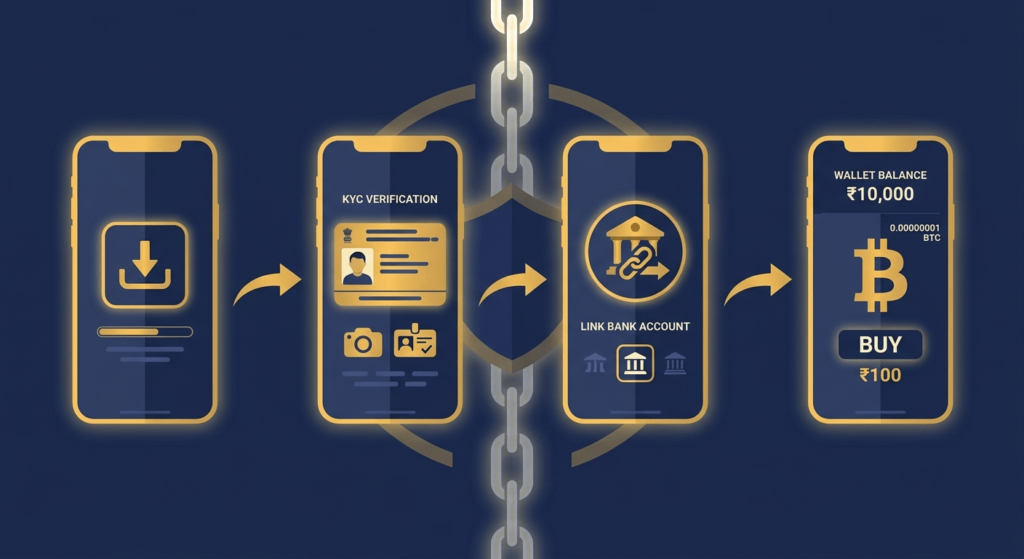
Part 5: How to Start (With ₹100, Not ₹1 Lakh)
Step 1: Choose an Exchange
An exchange is just an app where you buy and sell crypto. Popular ones in India:
- CoinDCX — Most user-friendly for beginners. KYC takes 10 minutes. App is clean. Fees are reasonable.
- WazirX — Owned by Binance. Good for beginners. Similar process.
- Kraken — International, if you want more coins to choose from.
All three have apps. All three require KYC (ID, selfie, address proof). Takes 10-30 minutes.
Pick one and download the app.
Step 2: Complete KYC
This is just identity verification. Same as opening a bank account.
Upload:
- Aadhar or PAN
- Selfie
- Address proof (can be Aadhar again)
Takes 10 minutes. Approval takes 1-2 hours.
Step 3: Link Your Bank Account
You'll add your bank account to the exchange. This lets you send rupees to the exchange and receive them back.
Step 4: Buy Your First Bitcoin/Ethereum
Search for "Bitcoin" on the app. Click "Buy."
Enter ₹100.
See the amount of Bitcoin you're getting (it'll be tiny — like 0.00001 BTC. That's normal).
Click confirm. Done.
You now own cryptocurrency.
Step 5: Decide: Keep It on Exchange or Move to a Wallet?
If you're keeping it for less than a year: Leave it on the exchange. It's easier to sell quickly.
If you're holding long-term: Move it to a hardware wallet (a device that looks like a USB drive). This costs ₹3,000-8,000 but is safer.
Popular hardware wallets: Ledger or Trezor. Both are available on Amazon in India.
Part 6: Understanding DeFi (The Slightly Advanced Part)
Skip this if you're a complete beginner. Come back to it in 6 months.
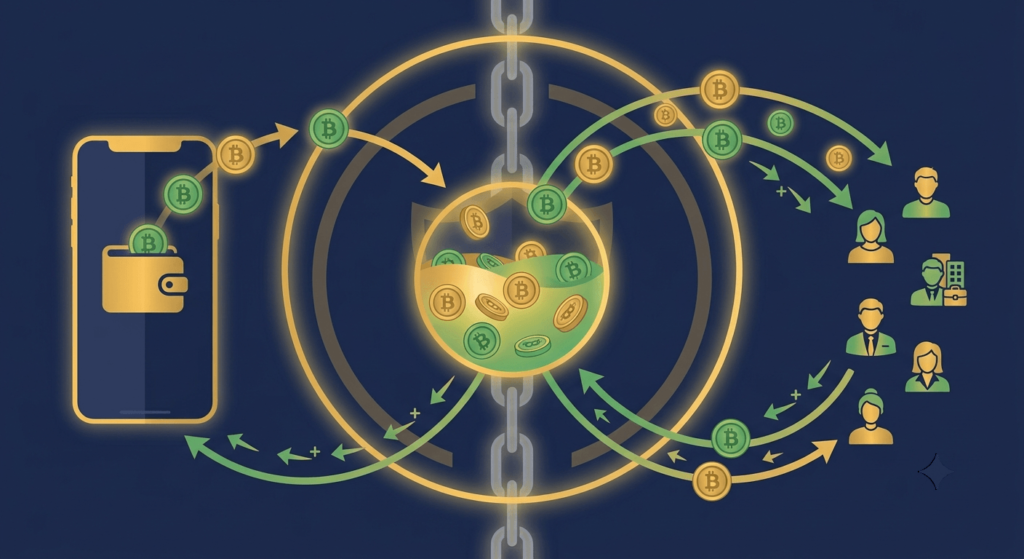
DeFi = Decentralized Finance. It means financial services (lending, borrowing, trading) that run on blockchains instead of banks.
Example: You have ₹1 lakh in an Ethereum wallet. You put it into a DeFi platform called Aave. Aave lends your money to people who need loans. The borrowers pay interest. That interest goes to you. You earn 5-8% per year.
Compare this to a savings account (3-4% interest) or an FD (6-7%).
But here's the catch: DeFi is riskier. The platform could get hacked. The code could have bugs. You could lose your money entirely.
For beginners: Don't do this yet. Master buying and holding Bitcoin first. Then, after 6-12 months, if you want extra returns, explore DeFi.
Part 7: The Tax Question (Yes, You Have to Pay)
India taxes cryptocurrency gains like any other investment.
If you sell ₹1 lakh of Bitcoin for ₹1.50 lakh, the ₹50,000 gain is taxable.
Tax rate depends on how long you held it:
- Less than 2 years: Short-term capital gains. Taxed at your income tax slab (15%, 20%, 30%, depending on your income).
- More than 2 years: Long-term capital gains. Flat 20% tax with indexation benefit (which reduces the taxable amount).
You also need to report all your crypto transactions in your ITR (income tax return). Starting in 2026, exchanges are reporting your transactions to the income tax department automatically.
Bottom line: If you make money on crypto, you'll pay tax on it. This is normal. Many people forget this, then panic when the tax department asks. Just plan for it upfront.
Part 8: A Real Example (Making Money, Not Getting Rich)
Meet Priya. She's 28. Works as a content writer. Makes ₹50,000/month.
In January 2024:
- She invests ₹5,000 in Bitcoin at ₹30,00,000 per Bitcoin. She gets 0.00167 BTC.
- She invests ₹5,000 in Ethereum at ₹2,00,000 per Ethereum. She gets 0.025 ETH.
For 12 months, she does nothing. Prices go up. Prices go down. She ignores it all.
By January 2025:
- Bitcoin is at ₹45,00,000. Her 0.00167 BTC is worth ₹7,500.
- Ethereum is at ₹3,00,000. Her 0.025 ETH is worth ₹7,500.
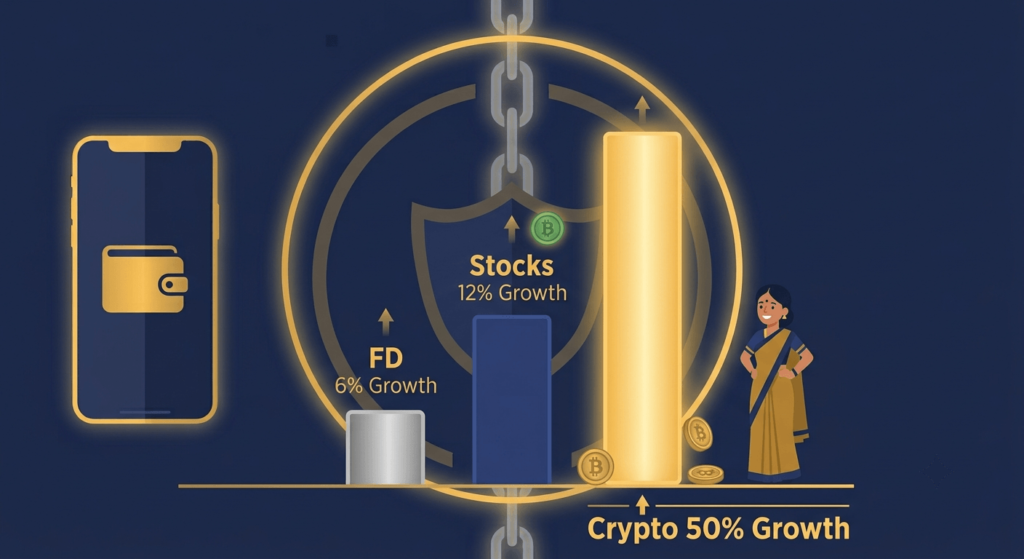
She made ₹5,000 profit on a ₹10,000 investment. That's a 50% gain in one year.
Compare this to:
- FD returns: 6% = ₹600 gain
- Stock market average: 12% = ₹1,200 gain
- Mutual fund SIP: 12% = ₹1,200 gain
Crypto gave her 5x better returns. But it was also way more volatile. There were days she was up ₹15,000. Days she was down ₹8,000.
The lesson: Crypto can outperform other assets. But it's not guaranteed. And the price swings will scare you. Only invest if you can handle seeing your money fluctuate wildly.
Part 9: The Beginner's Checklist
- [ ] Download CoinDCX, WazirX, or Kraken
- [ ] Complete KYC (takes 30 minutes)
- [ ] Link your bank account
- [ ] Buy ₹100-500 of Bitcoin or Ethereum (just to see how it works)
- [ ] Don't check the price for a week (so you don't freak out at volatility)
- [ ] After 1 week, set a plan: Will you hold for 1 year? 5 years? Just experimenting?
- [ ] If holding long-term, decide: Keep on exchange or buy a hardware wallet?
- [ ] Don't buy any other coin until you've held Bitcoin for 6 months
- [ ] When you make profit, remember to file it in your ITR
The Truth About Crypto in 2026
Crypto is not a get-rich-quick scheme. If someone's promising you guaranteed returns, they're lying.
Crypto is not a scam. But 99% of new coins are. Stick to Bitcoin and Ethereum.
Crypto is not replacing banks. But it's becoming a useful parallel system for certain things — international transfers, stores of value, programmable money.
Crypto is not for everyone. If you can't afford to lose ₹5,000 without stress, don't invest in crypto yet. Build your emergency fund, then explore.
50 million Indians have already started. Most of them aren't rich. Most of them aren't getting rich. They're just using it as one part of their overall financial strategy — like stocks, like real estate, like insurance.
You can start with ₹100. You don't need ₹1 lakh. You don't need a "hot tip" from your friend. You don't need to understand blockchain to own Bitcoin.
You just need curiosity. And a little bit of caution.
Related Articles You Should Read:
- How to Start a SIP in India in 2026 — A Step-by-Step Beginner's Guide
- Smart Investment Strategies for Beginners to Build Wealth in 2026
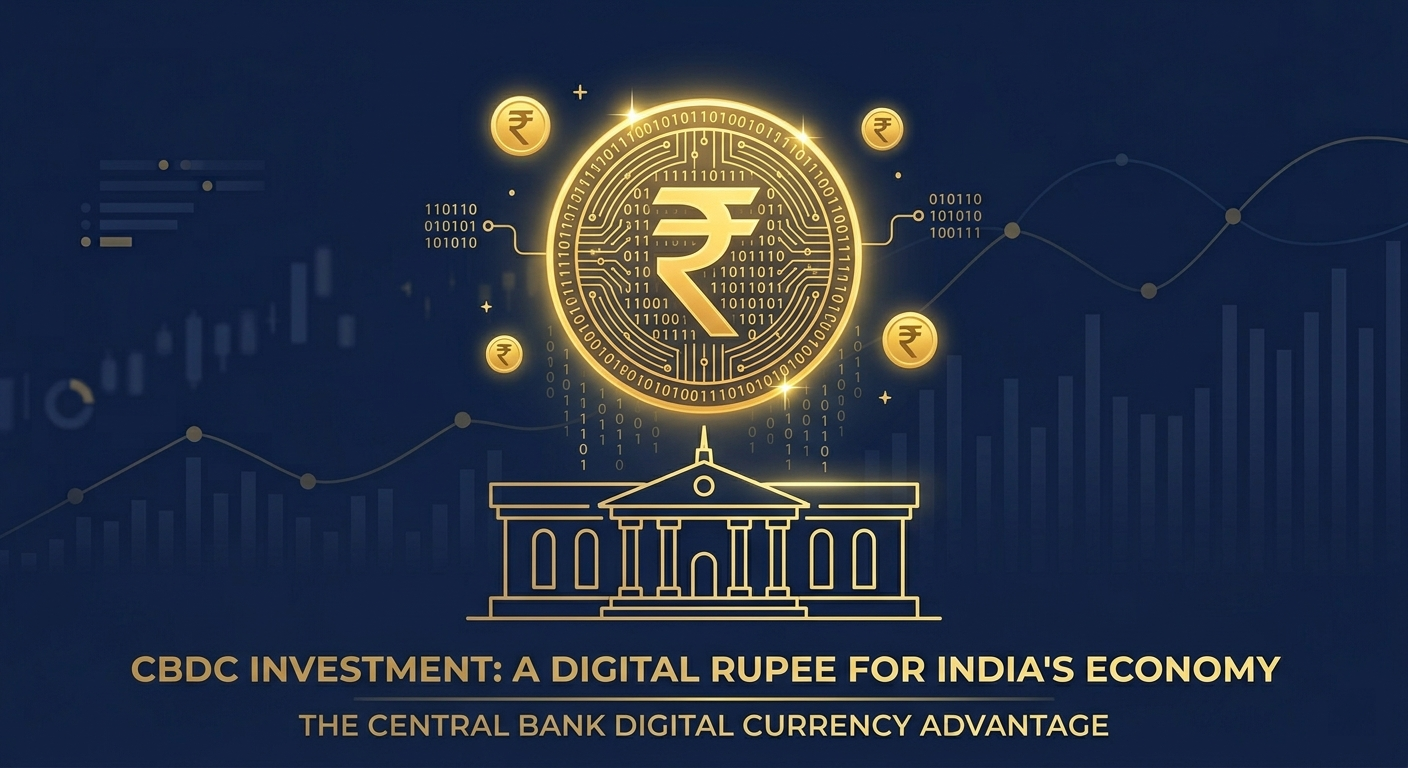
- The Rise of Central Bank Digital Currencies (CBDCs) and Their Impact on Retail Investors
- AI in Personal Finance: How AI Tools Are Transforming Investment Strategies in 2026
Disclaimer: This article is for educational purposes only and does not constitute investment advice. Cryptocurrency is highly volatile and risky. You can lose your entire investment. Past performance does not guarantee future results. Always do your own research (DYOR) before investing in any cryptocurrency. Consult a SEBI-registered financial advisor before making investment decisions. Laws regarding cryptocurrency in India are evolving. Stay updated with the latest regulations.



Leave a Reply